New to the Netherlands? Words with a have a short explanation. Tap or click them.
The Dutch love insurance. There is insurance for your things, your phone, your pet, your holiday, your lawyer and even your funeral. Your bank, your new phone shop and your colleagues will all tell you to take some out. But only two types are required by law, and many others cost more than they will ever pay you back. This guide explains each type in simple words, and gives real examples of when it's worth it and when it isn't. So you can decide for yourself, and not just buy everything.
The idea in simple words
Insurance works like this: many people each pay a small amount every month into one big pot. The few people who have bad luck get money from the pot. The insurance company keeps part of the pot for its costs and its profit.
That last part matters. On average, people pay more for insurance than they get back. So insurance is not a way to save money. It's a way to protect yourself from a disaster you could never pay for yourself. For small problems that you can pay with your own savings, insurance is usually a bad deal.
The most important facts
- Only two types are required by law: health insurance for everyone who lives or works here, and third-party insurance if you own a car, motorbike or moped.
- Liability insurance is the one most people should have. It's cheap, often a few euros a month, and it pays if you accidentally cause damage to someone else. That damage can cost tens of thousands of euros or more.
- Contents insurance depends on what you own. With a fully furnished home, yes. With a suitcase in a furnished room, maybe not.
- Legal expenses insurance doesn't help with a problem you already have. With a low income, the government already helps pay for a lawyer.
- Insurance sold with a phone, laptop or washing machine is often unnecessary. You already have a legal guarantee from the shop.
- Life insurance mostly matters if you have a mortgage and a partner or children who depend on your income.
- On top of the price, you pay 21% insurance tax on most insurance. It's included in the price you see.
Words you need to know first
- Insurance company (verzekeraar): the company that sells the insurance and pays when something happens.
- Policy (polis): your insurance contract. The policy conditions (polisvoorwaarden) are the small print: exactly what is and isn't paid for.
- Premium (premie): the amount you pay for the insurance, usually every month.
- Cover (dekking): what the insurance pays for.
- Deductible (eigen risico): the part of the damage you always pay yourself. A higher deductible makes the premium lower.
- Insured amount (verzekerd bedrag): the most the insurance will pay.
- Claim (schade melden): asking the insurance company to pay for damage.
- Liable (aansprakelijk): when the law says you must pay for damage you caused to someone else.
The one question to ask
For every insurance anyone offers you, ask yourself one question. The Dutch budget institute Nationaal Instituut voor Budgetvoorlichting: an independent Dutch organisation that gives advice about money and household budgets. gives the same advice: could you pay for the damage yourself?
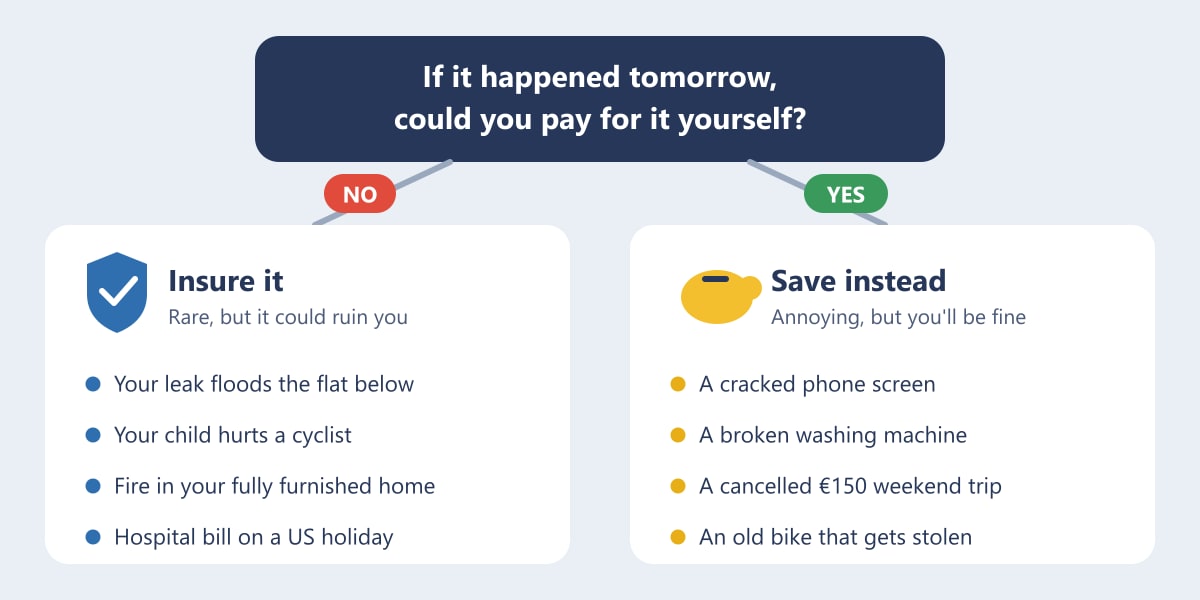
- No, it would ruin me. The damage is rare, but very expensive. For example: water from your flat leaks into your neighbour's flat, or your child causes an accident. This is what insurance is for.
- Yes, it would hurt, but I'd be fine. The damage is annoying, but you could pay it from your savings. For example: a cracked phone screen or a broken washing machine. Here, it's usually cheaper to put the premium in a savings account each month and pay for it yourself.
The answer is different for different people. Someone with €10,000 in savings can skip insurance that someone with €200 in the bank might need. That's why this guide doesn't say "everyone needs this". It tells you when it makes sense.
What's required by law
- Health insurance (zorgverzekering): required for everyone who lives or works in the Netherlands. Our guide on health insurance explains it.
- Third-party vehicle insurance (WA-verzekering): required for every car, motorbike, moped and speed pedelec. Read more in expats and cars.
Everything else is your choice. But two other people can make insurance a condition:
- Your landlord may write in the rental contract that you must have liability or contents insurance. Read your contract.
- Your mortgage lender requires building insurance if you buy a home with a mortgage.
All types at a glance
| Insurance | Pays for | Worth it for | Often not worth it for |
|---|---|---|---|
| Liability (aansprakelijkheid, AVP) | Damage you accidentally cause to other people or their things | Almost everyone, especially families and pet owners | Hardly anyone |
| Contents (inboedel) | Your own things after fire, water damage, storm or burglary | Anyone with a furnished home or expensive things | People who own very little, like a student in a furnished room |
| Building (opstal) | The house itself: walls, roof, floors, kitchen | Home owners (required with a mortgage) | Tenants: that's the landlord's job |
| Legal expenses (rechtsbijstand) | A lawyer or legal adviser when you have a conflict | People with a middle or high income, home owners, people without a union | People with a low income, or who already have a conflict |
| Travel (reis) | Medical costs abroad above the Dutch price, getting you home, lost luggage | Trips outside Europe, winter sports, expensive luggage | Short, cheap trips within Europe, if you already have other cover |
| Life (overlijdensrisico, ORV) | A lump sum for your family when you die | People with a mortgage and a partner or children who depend on them | Single people without children or a mortgage |
| Phone or gadget insurance, extra guarantee | Repairs, theft or damage to a device | Rarely: maybe for an expensive phone, if you often break things | Most people |
| Funeral (uitvaart) | The costs of your funeral | People who can't save for it | People who have savings |
Liability insurance: the one most people should have
In the Netherlands, if you cause damage to someone else, you're liable: you must pay for it. There is no maximum. If someone gets hurt and can't work for years, the bill can be hundreds of thousands of euros. In Dutch: aansprakelijkheidsverzekering particulieren, often shortened to AVP. Insurance that pays when you or your family accidentally cause damage to other people or their things. pays this for you.
Parents are liable for their children. If a child under 14 causes damage, the parents must pay, even if they weren't there. Pet owners are liable for damage their pet causes, even if it wasn't their fault.
Realistic examples
- Paid by liability insurance: your washing machine hose breaks, and water runs through the floor into the flat below. Your downstairs neighbour's ceiling, sofa and laptop are ruined.
- Paid: your 8-year-old rides into a parked car with their bike and scratches it.
- Paid: your dog jumps at a cyclist, who falls and breaks an arm.
- Paid: at a friend's dinner, you knock their phone off the table.
- Not paid: damage to your own things. That's contents insurance.
- Not paid: damage you cause on purpose.
- Not paid: damage with a car or moped. That's the vehicle insurance.
- Often not paid, or only partly: damage to things you rented or borrowed, like a borrowed camera or a rented flat. Insurers call this opzicht. Policies differ a lot here, so read the conditions if this matters to you.
Our honest view
Worth it for almost everyone. The chance that you need it is small, but the damage can be huge, and the premium is low: often around €3 to €6 a month for a single person or a family. That's exactly the kind of risk insurance is made for. Good to know:
- Choose an insured amount of at least €1.25 million. €2.5 million costs only a little more.
- The policy covers your household: you, your partner and your children living with you. Flatmates are not covered by your policy. Each needs their own.
- Have liability insurance from your home country? It usually only covers people who live there. Check before you rely on it.
Contents insurance: depends on what you own
In Dutch: inboedelverzekering. Insurance for everything in your home that you would take with you when you move: furniture, clothes, electronics, bikes in your shed. pays when your own things are damaged or stolen. A simple test: contents are everything you would take with you if you moved house.
Most policies pay for: fire, smoke, storm, water from a burst pipe or leaking washing machine, burglary (usually only when there are signs of a break-in), and vandalism. An all-risk policy also pays for accidents at home, like dropping your TV. That costs more.
Realistic examples
- Worth it: a couple renting an unfurnished flat. They bought a sofa, a bed, a dining table, a TV, two laptops and two bikes. If it all burned, replacing it would cost €20,000 or more. They don't have that in savings.
- Worth it: a family that owns a home full of furniture, toys and electronics.
- Maybe not worth it: a student or young professional in a furnished room. The furniture belongs to the landlord, and the landlord insures it. Their own things are a laptop, a phone and clothes, worth maybe €2,000. If they have that much in savings, they could choose to skip it.
- Watch out: even in a furnished room, a fire you cause can damage the landlord's things. That's a liability question, not contents, and as said above, rented things are often only partly covered.
Things to know before you buy
- Insure the right amount. If you insure too little (called underinsurance, or onderverzekering), the insurer pays only part of the damage. Many insurers use a calculator from the Dutch insurers' association, the inboedelwaardemeter, to set the amount. If you fill it in honestly, many give a guarantee against underinsurance.
- Did you improve your rental home? For example, you paid for a new kitchen or floor yourself. That's not covered by your landlord's insurance. You can add it to your contents insurance as huurdersbelang (tenant's improvements).
- Things outside your home, like a laptop stolen from your car or a phone lost on the street, are often not covered, or only up to a small amount. Read the conditions.
Building insurance: only for home owners
In Dutch: opstalverzekering. Insurance for the building itself: walls, roof, floors, windows, fixed kitchen and bathroom. pays for damage to the house itself, for example after a fire or a storm. If you buy a home with a mortgage, the bank requires it. Tenants don't need it: the landlord insures the building.
Own an apartment? Then the Vereniging van Eigenaars: the association of all owners in an apartment building. Every owner must be a member. It arranges the shared parts of the building. usually insures the whole building for all owners together. Check this before you take out your own building insurance, or you'll pay twice. Our guide on what to check before you buy a home explains more.
Legal expenses insurance: useful for some, not for all
In Dutch: rechtsbijstandverzekering. Insurance that pays for legal help, like a lawyer, when you have a conflict. pays for legal help when you have a conflict, for example with your employer, your landlord, a shop or after a traffic accident. A complete policy often costs a couple of hundred euros a year. Many people pay for it for years and never use it.
The big limits
- It never helps with a problem you already have, or one you could see coming. Buying it after your boss threatens to fire you is too late.
- There is often a waiting period (wachttijd): a few months before you may use it, especially for work problems.
- Each part costs extra. Cheap policies often leave out work, housing or family conflicts.
Free and cheaper alternatives
- Juridisch Loket: free legal advice from the government. Call 0800 8020, or chat on their website.
- Subsidised lawyer (toevoeging): with a low income, the government pays most of your lawyer. In 2026, this is possible with an income up to €35,400 if you live alone, or €50,000 with a partner or children (based on your income of 2 years earlier). You pay a part yourself.
- A union (vakbond): membership usually includes legal help with work problems. Often you must be a member for some months first.
- Cheap official routes: for many problems, like rent that's too high or a webshop that won't pay back, you don't need a lawyer. Our guide where to complain explains them.
Realistic examples
- Worth thinking about: you earn a good salary, so you don't get a subsidised lawyer. You're not in a union. You've just bought a home, with neighbours on both sides. A conflict with an employer or a builder could cost you thousands in lawyer fees.
- Probably not worth it: a student with a low income. They can get free advice and a subsidised lawyer if needed.
- Too late: you already have a conflict with your landlord about your deposit. A new policy won't cover it. Go to the Juridisch Loket.
Travel insurance: depends on where you go
Many people think they need travel insurance for medical costs. Partly true. Your Dutch basic health insurance already pays for urgent care abroad, but never more than the same care would cost in the Netherlands. In the EU, show your European Health Insurance Card: a card from your Dutch health insurer that gives you access to necessary care in public healthcare in EU countries, plus Iceland, Liechtenstein, Norway, Switzerland and the UK. card at public hospitals and doctors, and you're mostly covered.
Outside Europe, and in private clinics, care can cost much more than the Dutch price. You pay the difference yourself, unless you have travel insurance or supplementary health insurance that covers it. Also, bringing you home (repatriëring) after a serious illness or accident is never paid by basic health insurance.
Realistic examples
- Worth it: a holiday in the United States, Canada or Asia. A night in hospital there can cost many thousands of euros, far above the Dutch price.
- Worth it: a winter sports holiday. Accidents are common, and a mountain rescue or helicopter is expensive.
- Worth it: you travel with expensive things, like a camera or laptop.
- Maybe not worth it: a weekend train trip to Antwerp with a backpack. You have your EHIC for medical care, and little to lose.
If you travel several times a year, a yearly travel policy is often simpler and cheaper than a new one for each trip. Before you buy, check what you already have: some supplementary health insurance and some credit cards include travel cover.
Cancellation insurance
In Dutch: annuleringsverzekering. Insurance that pays back your trip if you must cancel it for a serious reason, like illness or a death in the family. pays your trip back if you must cancel for a serious reason, like illness. It's worth it for an expensive trip that you can't get your money back for, like a big family holiday booked months ahead. For a €150 weekend trip, it usually isn't. And "I changed my mind" is never a reason it pays for.
Life insurance: for people with a mortgage and a family
A In Dutch: overlijdensrisicoverzekering, ORV. It pays a fixed amount of money if you die before a certain date. If you're still alive at the end, it pays nothing. pays a fixed amount when you die. It's there to protect the people who depend on your income.
Why think about it in the Netherlands? The government's survivor's benefit, the Algemene nabestaandenwet: a Dutch benefit for a partner whose partner died. It's paid by the SVB., is small and strict. Your partner only gets it if they care for a child under 18 living at home, or if they can't work for at least 45% of the time. In 2026, the most it pays is about €1,698 a month before tax, and less if your partner has their own income.
- Worth it: you bought a home together with a mortgage based on two incomes. If one of you dies, the other can't pay the mortgage alone. Some banks ask for this insurance with a mortgage.
- Worth it: you have young children, and your partner earns little or nothing.
- Not needed: you're single, rent your home, and nobody depends on your income.
Employers often have a partner's pension in their pension plan. Check your pension overview first: you may need less than you think. Our guide on your Dutch pension explains it.
Freelancers: what happens if you get sick?
If you're employed and get sick for a long time, Dutch law protects your income: first your employer keeps paying, later the government's disability benefit may follow. If you're self-employed, you get none of that. A disability insurance for the self-employed (arbeidsongeschiktheidsverzekering, AOV) is often expensive. Some freelancers instead join a broodfonds: a group of freelancers who each put money aside and support a member who gets sick. Our guide on side jobs and freelancing has more about working for yourself.
Insurance you can usually skip
- Insurance sold with a phone, laptop or washing machine, and extra guarantees. The Dutch consumers' association, the Consumentenbond, found in 2026 that this is often unnecessary. You already have a legal guarantee: if the device breaks because of a fault, the shop must fix it for free, often for longer than 2 years. Damage at home may already be covered by an all-risk contents policy. The exception: if you often drop or lose your phone, and it's expensive, insurance against accidents and theft can make sense. Compare the premium with the price of a new screen.
- Funeral insurance (uitvaartverzekering). It's very popular in the Netherlands, and it's sold a lot. But if you have savings, or your family does, you don't need it. If you start young and pay for decades, you can end up paying more in premiums than the funeral costs.
- Accident insurance (ongevallenverzekering). It pays a fixed amount after a serious accident. Your medical costs are already paid by your health insurance.
- Pet insurance. It depends. An operation for a dog can cost hundreds or thousands of euros, so it can help if you can't pay that. But there are many exceptions, especially for older animals and conditions they already had. The alternative: put the premium in a savings account for the vet.
- Bike insurance for a cheap or old bike. For an expensive e-bike, it can be worth it. Our guide on buying a bike explains the lock rules insurers use.
Three example households
| Who | Probably worth it | Probably not needed |
|---|---|---|
| Priya, 24, works in Amsterdam, rents a furnished room, owns a laptop and a second-hand bike, has €4,000 in savings | Health insurance (required) and liability insurance. Travel insurance for her trip home to India. | Contents (she could replace her things from savings), legal expenses (low income: Juridisch Loket and a subsidised lawyer), phone insurance, funeral insurance |
| Tom and Ana, 32 and 34, both work, rent an unfurnished flat on the third floor, no children | Liability insurance (one leak can damage the flats below), contents insurance (their furniture and electronics), a yearly travel policy if they fly often | Building insurance (the landlord's job), life insurance (no mortgage, no children), gadget insurance |
| The Kim family: two parents and two young children, they bought a house with a mortgage, one parent works part-time | Liability, contents and building insurance (required by the bank), life insurance for the parent with the higher income, maybe legal expenses insurance | Funeral insurance if they have savings, accident insurance, extra guarantees on appliances |
How to choose and pay less
- Check what you already have. Your employer, your bank account, your credit card or your partner's policy may already cover some things. Don't pay twice for the same cover.
- Compare. Use a comparison website or the Consumentenbond. Compare the same insured amount and deductible, not just the price.
- Choose a higher deductible if you can pay small damage yourself. The premium goes down.
- A package or separate policies? Insurers often sell liability, contents and legal expenses together in a package (pakket), with a small discount. That's fine, as long as you only add what you need.
- Tell the truth on the application form. If you leave out important information, like earlier claims or a criminal record, the insurer can refuse to pay later.
- Read the main exclusions before you sign: what is not paid for.
Cancelling or switching
- After the first year, Dutch insurers have agreed that you can cancel at any time, with at most 1 month's notice. Many insurers also allow it in the first year.
- Leaving the Netherlands? Cancel your Dutch policies from your moving date. Our leaving the Netherlands checklist lists them.
- Insurer won't pay? First use the insurer's complaints procedure. Still not solved? Most insurers are members of Klachteninstituut Financiële Dienstverlening: an independent Dutch organisation that handles complaints about banks and insurers., which handles your complaint for free.
Your checklist
- Take out health insurance (required), and vehicle insurance if you have a car, motorbike or moped (required).
- Read your rental contract or mortgage offer: does it require any insurance?
- Take out liability insurance for your household, with at least €1.25 million cover.
- Add up what your things are worth. Could you replace them from your savings? If not, take out contents insurance for the right amount.
- Check your income against the limits for a subsidised lawyer before you buy legal expenses insurance.
- Before each trip, check: is my medical cover enough for this country? Is my luggage valuable?
- Have a mortgage and a family? Think about life insurance, and check your partner's pension first.
- Say no to insurance at the checkout of the electronics shop, unless you've thought it through.
- Once a year, check all your policies. Cancel what you no longer need.
Official sources and useful links
- Nibud: costs of insurance and which you need (Dutch)
- Consumentenbond: is liability insurance required? (Dutch)
- Consumentenbond: insurance sold with appliances often unnecessary, 2026 (Dutch)
- ConsuWijzer (ACM): your legal guarantee (Dutch)
- Dutch Association of Insurers: contents value calculator (Dutch)
- Rijksoverheid: do I need legal expenses insurance? (Dutch)
- Legal Aid Board: income limits for a subsidised lawyer in 2026 (Dutch)
- Juridisch Loket: free legal advice
- Rijksoverheid: health cover on holiday abroad (Dutch)
- SVB: conditions for the survivor's benefit (Anw) (Dutch)
- Belastingdienst: the 21% insurance tax (Dutch)
- Kifid: complaints about insurers
This is general information based on the rules and amounts in November 2026. It is not personal financial advice. Every policy has its own conditions, so always read what is and isn't covered before you sign.