The Netherlands is famous for bikes, but many expats still need a car for the commute, the school run or weekend trips. Having a car here comes with a lot of Dutch rules and terms: licence exchange, foreign plates, RDW checks, BPM, MRB, APK and three kinds of insurance. There is too much to cover in one article, so this page gives you a short overview of each part. Each section links to a full guide from our partners at DealerCenter.
The essentials at a glance
- Check your licence first: a non-EU/EFTA licence can usually only be used for the first 185 days after you move here.
- There is no automatic 6-month period for foreign plates: once you live here, BPM and MRB may be due from your first day on Dutch roads.
- Buying from a dealer gives you more legal protection than buying from a private seller.
- WA insurance is mandatory from the moment the car is registered in your name.
- Work out the total monthly cost (depreciation, tax, insurance, fuel and maintenance), not just the purchase price.
1. Before you drive: your licence and your plates
Driving licence. Licences from EU/EFTA countries generally stay valid here. For a car licence (category B), that is up to 15 years from the date it was issued, after which you exchange it for a Dutch one. Licences from outside the EU/EFTA are different: you can usually use them only for the first 185 days after you move, and applying for an exchange does not extend that period. Only some countries, and expats with a qualifying tax ruling, can exchange their licence without taking a Dutch driving test. Tell your insurer where your licence is from and get their acceptance in writing. Read the full driving licence guide →
Driving a car with foreign plates. A lot of expats believe they have six months before they need to deal with this. That is a myth. Once you are a Dutch resident, you may owe BPM (purchase tax) and MRB (road tax) from the first day you drive on Dutch roads. The main exception is the relocation exemption (verhuisgoederen), which has strict conditions: you lived abroad for at least 12 months, owned the car for at least 6 months before the move, and import it within 12 months. Cameras that read number plates (ANPR) make foreign plates easy to detect. Read the full foreign plates guide →
2. Choosing the right car
Electric, petrol or hybrid? Choose based on how you actually drive, not on fashion. An electric car makes sense for regular routes when you can charge reliably at home or work. Petrol suits drivers who do low mileage or unpredictable trips. A regular hybrid saves fuel in city and stop-start traffic without needing a plug. A plug-in hybrid only saves money if you actually charge it. Compare the options →
Reliable family cars. Five models built after 2020 do well in owner surveys and breakdown statistics: the Kia Ceed, Honda Civic e:HEV, Kia Niro, Skoda Karoq and Volkswagen Passat Estate. A good model still does not guarantee a good individual car, so you need to check the specific car you are buying. See the shortlist →
How the Dutch market works. More than 2.1 million used cars changed hands in the Netherlands in 2025. Most people search on Marktplaats, AutoTrack and AutoScout24. Compare prices with other Dutch listings, not with prices abroad, because BPM affects what cars cost here. Ask for the total drive-away price before you start negotiating. Read the market guide for expats →
3. Buying a used car without regrets
Run a check with the RDW (the Dutch vehicle authority). The free kentekencheck shows whether the car can be transferred to you, whether it has been reported stolen, when its APK (roadworthiness test) expires, any open recalls, and whether the mileage history looks logisch (logical). However, it does not tell you about the engine, the gearbox or past accidents. How to read an RDW report →
Inspect the car yourself. Look for paint that doesn't match and uneven gaps between panels, check for rust on the wheel arches and sills, start the engine from cold, and take a test drive of 20 to 30 minutes that includes the motorway. An independent inspection usually costs between €150 and €350. If the seller won't allow one, take that seriously. The 10-point checklist → · Spotting hidden defects →
Dealer or private seller? When you buy from a dealer, Dutch consumer law applies: the car must be what you could reasonably expect, and if a fault appears in the first 12 months, it is usually up to the dealer to prove it was not already there. Writing "no warranty" in the contract does not remove these rights. When you buy from a private seller, you get none of this protection. Also note that a BOVAG membership is not the same as a BOVAG warranty: the warranty only applies if it is written into your contract. Know your rights →
Walk away if you see these red flags
- The seller refuses an independent inspection.
- The price is far below market value and there is no explanation.
- You are told to "decide today".
- The VIN (vehicle identification number) is different on the documents and on the car.
- The seller is "abroad" and offers to ship the car to you.
4. Paperwork: registration and insurance
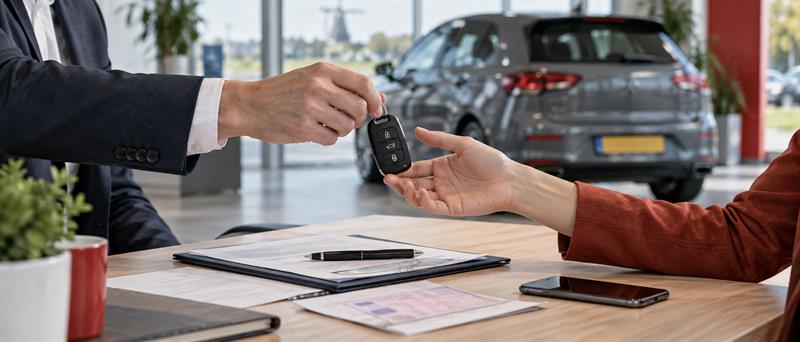
Registration and handover. To put a car in your name, you need to be at least 18 and registered at a Dutch address in the BRP (the municipal population register). From 2026, an RDW-approved counter will ask for a valid Dutch driving licence. If you don't have one yet, you can register the car online with DigiD or at an RDW location with your passport. Do things in a safe order: sign the contract, transfer the registration, pay with a traceable method, and make sure your insurance is active before you drive away. Store the nine-digit tenaamstellingscode (registration code) safely at home, because you will need it when you sell the car. The handover checklist →
Insurance. WA (third-party liability) insurance is required by law. WA+ (beperkt casco) also covers theft, fire, storm and broken windows. All Risk (volledig casco) also covers damage you cause to your own car. Choose based on the car's real value and on how big a loss you could pay for yourself. If you have no-claims history from abroad, ask your previous insurer for a dated statement, because some Dutch insurers will count it. WA, WA+ or All Risk? →
5. What a car really costs
Car taxes. BPM is a one-off tax based on CO2 emissions. When you buy a car that is already registered in the Netherlands, BPM is already included in the price. When you import a car, you pay it yourself. MRB (road tax) is a recurring tax, and wegenbelasting is simply the everyday name for the same thing. It depends on the car's weight, fuel type and your province, and diesel cars pay considerably more. In 2026, fully electric cars pay 70% of the MRB for a comparable petrol car. Dutch car taxes explained → If you are thinking of importing a car, get a rough idea of the BPM with our free import tax calculator.
The real monthly cost. Add up depreciation, MRB, insurance, fuel or charging, maintenance, tyres, APK and parking. Depreciation alone can be big: a €15,000 car that you sell for €9,000 after three years costs you about €167 a month. The cheapest car in the listings is rarely the cheapest car to own. Build your monthly budget →
Dutch car terms you will come across
| Term | What it means |
|---|---|
| RDW | The Dutch vehicle authority. It handles registration, inspections and vehicle reports. |
| APK | The periodic roadworthiness test, similar to the UK MOT. |
| BPM | A one-off purchase or import tax based on CO2 emissions. |
| MRB / wegenbelasting | Recurring road tax. Both names refer to the same tax. |
| WA / WA+ / All Risk | The three levels of car insurance: third-party only, limited comprehensive, and fully comprehensive. |
| Kentekencard | The credit-card-sized registration certificate. |
| Tenaamstellingscode | The nine-digit registration code you need to sell, suspend or scrap the car. |
| Meldcode | The last four digits of the VIN. Insurers often ask for it. |
| Vrijwaringsbewijs | The certificate the seller receives to prove the car is no longer theirs. |
This article only gives an overview. Rules, rates and deadlines change, so check your own situation with the RDW, the Belastingdienst (Dutch tax authority) and your insurer before you buy, import or drive.
Want the full details?
DealerCenter has in-depth, expat-friendly guides on every topic above, from your first RDW check to the day you collect the keys. Read all car articles on DealerCenter →