New to the Netherlands? Words with a have a short explanation. Tap or click them.
In the Netherlands, a bike isn't a hobby. It's how people get to work, school, the shops and the train station. Most newcomers buy one in their first weeks. But where do you buy one? New or second-hand? Is an electric bike worth it? And how do you make sure it isn't stolen, or doesn't get stolen? This guide explains it step by step, with the rules and prices for 2026.
The idea in simple words
Buying a bike here is easy. Keeping it is the hard part. A lot of bikes get stolen, and many second-hand bikes for sale were stolen before. So there are three things to get right:
- Buy the right bike for how far you ride and where you live.
- Buy it from someone you can trust, and check that it isn't stolen.
- Lock it well, every time, with two locks.
The most important facts
- Buying a bike that you could have known was stolen is a crime, even if you paid for it. If the police find it, it goes back to the owner, and you lose your money.
- Check every second-hand bike before you pay: look up its frame number in the free stolen bike register of the Rijksdienst voor het Wegverkeer: the Dutch government office for vehicles. It also keeps the register of stolen bikes..
- A normal e-bike helps you up to 25 km/h. You don't need a licence, number plate, helmet or insurance. A faster speed pedelec counts as a moped, and then you do.
- An e-bike cost about €2,900 on average in 2025. A new battery for an older e-bike costs at least €400 to €600.
- Use two locks, and lock the frame to something that can't move. Many insurers want locks with at least 2 A Dutch quality mark for locks. A lock gets 1 to 5 stars. More stars means the lock is harder to break..
- Bike stolen? First check your town's bike depot. Then report it to the police. Only reported bikes can be found and given back.
- Children under 8 must sit in a safe seat on the bike, with support for their back, hands and feet.
Words you need to know first
- Frame: the metal body of the bike, which holds everything together.
- Frame number (framenummer): a unique code stamped into the frame, usually under it near the pedals. It's like the bike's ID number. It's usually two letters and seven numbers.
- Bike shop (fietsenwinkel) and bike mechanic (fietsenmaker): the shop that sells and repairs bikes. In the Netherlands, it's often the same shop.
- Back-pedal brake (terugtraprem): many Dutch bikes have no brake on the handlebars for the back wheel. You brake by pushing the pedals backwards. Try it first, somewhere quiet!
- Gears (versnellingen): they make pedalling lighter or heavier. Dutch city bikes often have 3 to 8 gears hidden inside the back wheel. Sports bikes have gears on the outside.
- Frame lock (ringslot): a lock fixed to the bike that blocks the back wheel.
- Chain lock (kettingslot): a heavy chain you use to lock the bike to a bike rack or post.
- Marktplaats: the biggest Dutch website for buying and selling second-hand things, from private people.
Which bike do you need?
Most of the Netherlands is flat, but the wind can be strong and the distances add up. Think about how far you'll ride every day, whether you carry children or shopping, and where you'll park.
| Type of bike | Good for | Good to know |
|---|---|---|
| Dutch city bike (stadsfiets, or the classic omafiets) | Short trips in town, to the station or the shops | You sit up straight. It's heavy and strong, with mudguards, lights, a stand and a frame lock. Thieves are much more interested in e-bikes and fatbikes. |
| Hybrid or sports bike | Longer rides, for example 10 km or more to work | Lighter and faster. It often needs more care, because the chain and gears are on the outside. |
| E-bike (elektrische fiets) | Longer distances, wind, hills, or arriving at work without sweating | A motor helps you when you pedal. Popular, but expensive, and popular with thieves too. |
| Cargo bike (bakfiets) | Families with young children, or lots of shopping | A big box at the front. Hard to park and expensive. Many are electric. |
| Folding bike (vouwfiets) | Combining a bike with the train | Free on the train at any time, when folded. |
| Fatbike | Mostly popular with teenagers | An e-bike with very thick tyres. The same rules as an e-bike apply, as long as it isn't tuned up (see below). |
E-bike, speed pedelec or fatbike: the rules
An electric bike is only a normal bike by law if it follows the rules. If it doesn't, it counts as a moped, and a lot more rules apply.
| E-bike (also e-cargo bike and fatbike) | Speed pedelec | |
|---|---|---|
| The motor helps you up to | 25 km/h, and you must pedal yourself. Motor of at most 250 watts. | 45 km/h |
| Driving licence | Not needed | A moped licence (AM), or a car licence. You must be 16 or older. |
| Number plate | Not needed | A yellow moped number plate |
| Helmet | Not required, but a good idea | Required. Not wearing one costs €120. |
| Insurance | Not required | Liability insurance is required by law |
| Where you ride | On the bike path | Often on the road, like a moped. Check the signs. |
- Tuned up (opgevoerd) means someone changed the bike so it goes faster than 25 km/h, or rides without pedalling faster than 6 km/h. That's not allowed. The fine is €320, the police can take the bike, and you aren't insured if you cause an accident. Watch out: some fatbikes are sold with a "turbo mode" or a throttle that does this.
- Coming soon: the government plans to make a helmet required for everyone under 18 on an e-bike or fatbike. Parliament still has to agree, so it isn't a rule yet.
Where to buy a bike
| Where | Good | Not so good |
|---|---|---|
| New, from a bike shop | Advice on size, a guarantee, and a shop that services your bike. You get a receipt with the frame number. | The most expensive way |
| Second-hand, from a bike shop | The bike has been checked and repaired. You still get a legal guarantee. Many shops sell used bikes. | A bit more expensive than from a private seller |
| Second-hand, from a private seller, for example on Marktplaats or Facebook | The cheapest way | Higher risk of a stolen or broken bike, and fewer rights if something is wrong |
| Bike subscription, for example Swapfiets | You pay a monthly fee, and repairs are included. Good if you're not sure how long you'll stay. Check what you pay if the bike is stolen. | Over a few years, it costs more than buying |
| Through your employer | Can be much cheaper because of tax rules (see below) | Not every employer offers it |
Your rights when something is wrong
- From a shop, new or second-hand: you always have a In Dutch: wettelijke garantie or conformiteit. By law, a product must work as you can expect, for as long as you can expect. This is separate from any extra guarantee the shop or brand gives.. The bike must work as you can expect for its price and age. If it doesn't, the shop must repair it, replace it, or give money back. If something breaks in the first year, the shop must prove it wasn't already broken when you bought it.
- Bought in a shop? You can't just change your mind and return it. In a shop, that's only possible if the shop allows it. When you buy online, you usually have 14 days to change your mind.
- From a private seller: you have far fewer rights. Check the bike well, take a test ride, and ask for the old receipt.
What does a bike cost?
- A new e-bike cost about €2,900 on average in 2025. Almost half of all new bikes sold in the Netherlands now have a motor.
- A new normal bike without a motor costs much less. Ask a few bike shops, and compare with their second-hand bikes.
- A used e-bike older than 5 years is often offered online for about €700 to €850. The battery decides most of its value: a new one costs at least €400 to €600.
- Keep money for a good lock. A strong chain lock costs more than a cheap one, but much less than a new bike.
How to avoid buying a stolen bike
Many second-hand bikes for sale were stolen. If you buy one, and you could have guessed it was stolen, you commit a crime called In Dutch: (schuld)heling. Buying, having or selling something that you knew, or could have guessed, was stolen.. The maximum punishment is a year in prison or a fine. In practice, the most likely result is that the police take the bike back to its owner, and your money is gone.
Warning signs
- The price is much lower than for similar bikes.
- The seller wants to meet on the street or at a station, not at home.
- There is no key for the frame lock, only one key, or the lock is broken.
- The seller has no receipt and doesn't know much about the bike.
- The seller is in a hurry, or sells a lot of bikes at the same time.
- The frame number is scratched away or painted over.
Check the bike in 3 steps
- Find the frame number. It's stamped into the frame, usually underneath, near the pedals. Some bikes also have a chip inside the frame.
- Look it up in the stolen bike register on the RDW website, rdw.nl. You need the brand and the frame number. The police's stopheling.nl lets you check too. It's free and takes a minute.
- Ask for the receipt (aankoopbon) and all keys. A receipt with the same frame number is the best proof that the bike is really theirs.
Good to know: a "not stolen" answer isn't a 100% guarantee. Many people never report a theft, and the register only has thefts from 2008 onwards. So also trust your feeling and the warning signs.
Paying a private seller safely
Pay when you pick up the bike, after the checks and a test ride. Never pay in advance for a bike you haven't seen. And never pay through a link the other person sends you in a chat. Criminals use fake payment links to steal bank details.
Check that the bike works
The Dutch cyclists' union, the Fietsersbond, advises checking these things on a second-hand bike:
- Brakes: do both brakes stop the bike well?
- Lights: do the front and back lights work?
- Frame: are there cracks or bent parts?
- Wheels: do they turn straight, without wobbling? Are any spokes loose or broken?
- Chain and gears: does it change gear smoothly? A rattling or slipping chain often needs replacing.
- Handlebars and saddle: can you adjust the height, or are they stuck with rust?
- Test ride: is the size right for you, and does it feel good to ride?
- Used e-bike: ask a bike shop to test the battery. It shows how much power it still holds.
What every bike must have by law
- Lights when it's dark or hard to see: white or yellow at the front, red at the back. They may not flash. Lights you clip on are fine.
- Reflectors: a red one at the back, white or yellow reflectors on the wheels or a reflective strip on the tyres, and yellow reflectors on the pedals.
- A working bell and working brakes.
Missing these can get you a fine. Our guide on fines nobody warns you about lists the bike fines for 2026.
Locking your bike so it stays yours
In 2025, people reported almost 87,000 stolen bikes to the police. But only about 1 in 4 thefts gets reported, so the real number is much higher. E-bikes and fatbikes are stolen most.
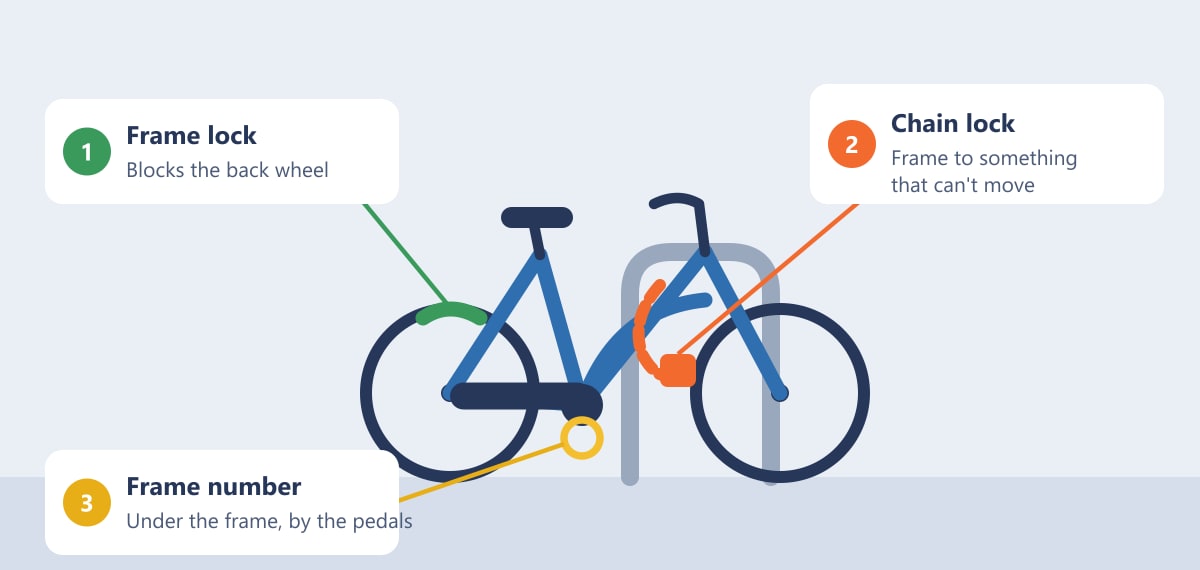
- Use two locks. The frame lock blocks the back wheel. The chain lock goes through the frame and around something that can't move.
- Lock the frame to something fixed, like a bike rack, a lamp post or a fence. A bike that's only locked to itself can be carried away and opened later.
- Choose locks with ART stars. ART is a Dutch quality mark: 1 to 5 stars, and more stars means harder to break. Many insurers ask for at least 2 stars. For e-bikes, some insurers want two locks with 2 stars each.
- Take the battery and display of your e-bike with you when you can. Thieves steal those too.
- Use guarded bike parking (bewaakte fietsenstalling) at stations and in city centres. At most NS stations, the first 24 hours are free. After that, it costs €0.65 or €1.50 a day in 2026, depending on the station.
- Write down your frame number and keep the receipt and a photo of your bike. You need them if it's stolen.
Park in the right place, too. Towns remove bikes parked outside the racks or for too long at a station. Our guide on getting around without a car explains how to rent an OV-fiets at the station and take your bike on the train.
Do you need bike insurance?
Bike insurance is never required for a normal bike or e-bike. It's mostly worth it for a new or expensive bike, like an e-bike or a cargo bike. Before you buy insurance:
- Read which locks it requires. If your lock doesn't meet the rules, the insurer may not pay.
- Check your home contents insurance (inboedelverzekering). Some policies pay when your bike is stolen from your locked home, shed or storage room, but not from the street.
- Keep the receipt and both keys. Insurers usually ask for them after a theft.
Your bike is gone: what to do
- Check the bike depot first (fietsdepot). Maybe your town removed it because it was parked in the wrong place. Many depots have a website where you can search by frame number.
- Report it to the police (aangifte doen). You can do this online on politie.nl with Your personal login for Dutch government websites, like a digital ID card., or at a police station. Give the frame number, or the chip number if your bike has one. Without it, add the brand, type and colour.
- Why report it? Only a reported bike goes into the stolen bike register. Without a report, the police can't give it back to you if they find it.
- Tell your insurer, if you have bike insurance, and send them the police report.
Cycling with children
- Children under 8 must have a safe place to sit on the bike, with support for their back, hands and feet. A child seat is the normal way.
- Front seat: once a baby can sit up by themselves, usually from about 9 to 12 months, until about 15 kg (around 3 years).
- Back seat: for children up to about 22 kg (around 5 years).
- Protect their feet. Use foot straps and a hard plastic spoke guard, so a foot can't get stuck in the wheel.
- A helmet isn't required for a child on a bike, but you may choose one.
- Babies who can't sit yet can only ride in a baby car seat fixed in a cargo bike or bike trailer.
Our guide on Dutch schools for expat children explains why so many Dutch children cycle to school on their own from a young age.
Getting a bike through your employer
Many Dutch employers help you buy a bike, because of tax rules. This is often called a In Dutch: fietsplan. A scheme from your employer that makes a bike cheaper for you through tax rules.. There are a few ways:
| How it works | What it means for you |
|---|---|
| A company bike or lease bike that you may also use privately | Each year, 7% of the bike's shop price is added to your salary on paper, and you pay tax on that. For a €2,000 bike that's €140 a year. With 35.70% tax, you pay about €50 a year, or €4.16 a month. Your employer may also pay that tax for you. |
| An interest-free loan from your employer to buy a bike | You don't pay tax on the loan. You often pay it back with your travel allowance. |
| Your own bike, with a travel allowance | Your employer may pay you up to €0.25 per kilometre, tax-free, in 2026, also for your trips to work. |
With a company bike, you can't also get a tax-free kilometre allowance for that bike. Ask your HR department what your employer offers.
Looking after your bike
- Pump up your tyres every few weeks. Soft tyres make cycling heavy and get flat more easily.
- Oil the chain now and then, especially after rain. In winter, roads have salt on them, which makes the chain rust.
- Check your lights before the dark months, from October.
- Let a bike shop check the bike once a year, especially an e-bike.
- Charge an e-bike battery indoors, and don't leave it in the cold for long.
Your checklist
- Decide how far you'll ride, and choose a city bike, sports bike or e-bike.
- Ask your employer about a bike plan before you buy.
- Buying second-hand? Check the frame number on rdw.nl, ask for the receipt and all keys, and take a test ride.
- Don't buy a bike that's suspiciously cheap or sold on the street.
- For an e-bike, make sure it isn't tuned up. For a used one, get the battery tested.
- Buy a good chain lock with ART stars, and always use two locks.
- Write down your frame number and keep the receipt, a photo and both keys.
- Check that your lights, reflectors, bell and brakes work.
- Bike gone? Check the depot, then report it to the police.
Official sources and useful links
- RDW: check if a bike is stolen (Dutch)
- Police: checking a bike online (Dutch)
- Police: report a stolen bike (Dutch)
- Rijksoverheid: what to do when your bike is stolen (Dutch)
- Rijksoverheid: rules for e-bikes, e-cargo bikes and fatbikes (Dutch)
- RDW: e-bike or speed pedelec (Dutch)
- Rijksoverheid: rules for bike lights and reflectors (Dutch)
- Rijksoverheid: children on the back of a bike (Dutch)
- VeiligheidNL: using a child bike seat safely (Dutch)
- Belastingdienst: how a bike plan from your employer works (Dutch)
- ConsuWijzer: your rights when a product is broken (Dutch)
- Fietsersbond: tips for buying a second-hand bike (Dutch)
- NS: guarded bike parking at stations
This is general information based on the rules and prices in November 2026. Rules for e-bikes and fatbikes are changing, and bike parking prices differ per station and town. Always check the latest rules before you buy.