New to the Netherlands? Words with a have a short explanation. Tap or click them.
Many people who move to the Netherlands never buy a car. Trains go almost everywhere, often several times an hour. Cities have buses, trams and metros. And for the last part of the trip, there is always a bike. But the system works a bit differently from most countries. There are no tickets to show the driver. Instead, you tap a card when you get on and again when you get off. This guide explains how that works, what it costs in 2026, which train subscription can save you money, and how your employer can pay for your trips to work.
The idea in simple words
In the Netherlands, you don't buy a ticket for each trip. You use a card, like your bank card, as your ticket. When you start your trip, you hold the card against a card reader. This is called checking in. When you finish your trip, you hold the same card against a reader again. This is called checking out. The system then knows how far you travelled and takes the right amount from your bank account.
It's that simple for one trip. You only need to think harder if you travel a lot. Then a subscription can make the train much cheaper, and your employer may pay part or all of it.
The most important facts
- You can travel with your own bank card or your phone on every train, bus, tram and metro in the country. This is called The Dutch system that lets you check in and out on public transport with your own bank card, credit card, phone or the new OV-pas.. Most foreign Visa, Mastercard, Maestro and V PAY cards work too.
- Always check in and out with the same card or phone. Forgot to check out of a train? You first pay a fixed €33.30. You can get most of it back.
- The old The Dutch public transport card you could load with money or a subscription. It's being replaced by the OV-pas and stops working at the end of 2027. stops at the end of 2027. Its replacement, the The new Dutch public transport card. It costs €6 and works with the OVpay system., costs €6.
- Off-peak travel is cheaper with a subscription. Off-peak means weekdays before 6:30, between 9:00 and 16:00, and after 18:30, plus all day at weekends and on public holidays.
- The cheapest NS subscription costs €6.35 a month and gives 40% off train trips in off-peak hours. One off-peak return trip a month is often enough to earn it back.
- Children up to 3 travel for free. Children aged 4 to 11 can travel on the train for free with an adult, with the free Kids Vrij subscription.
- Your employer may pay for your trips to work, tax-free: up to €0.25 per kilometre in 2026, or the real price of your tickets.
Words you need to know first
- Public transport (openbaar vervoer, often written as OV): trains, buses, trams and metros that everyone can use.
- NS (Nederlandse Spoorwegen): the Dutch railway company. It runs most trains in the country.
- Checking in and checking out (inchecken and uitchecken): holding your card or phone against a card reader at the start and at the end of your trip.
- Card reader: a small machine where you tap your card. At stations, it's on a pole or on the gates (poortjes). In buses and trams, it's near the doors.
- Peak hours (spits): the busy times when most people travel to and from work. On weekdays, that's 6:30 to 9:00 and 16:00 to 18:30.
- Off-peak hours (daluren): all the other times. Weekends and public holidays are off-peak all day.
- Subscription (abonnement): a monthly payment that gives you a discount or free travel.
- Sprinter and Intercity: the two main types of train. A Sprinter stops at every station. An Intercity only stops at bigger stations, so it's faster.
Can you live without a car?
In and around the big cities, yes, easily. Amsterdam, Rotterdam, The Hague, Utrecht, Eindhoven and many smaller cities have trains every few minutes and buses or trams on most streets. Many people there find a car more trouble than it's worth: parking is hard to find and expensive.
In the countryside, it's harder. Buses may come only once or twice an hour, and less often in the evening and at weekends. Many people living outside the cities use a mix: a bike to the station, the train for longer trips, and a shared or rented car for the odd day out. Thinking about a car anyway? Our guide on expats and cars explains what owning one really costs.
Who runs the trains, buses and trams?
Many different companies run public transport, but you don't need to know them all. The payment system is the same everywhere, so one card works on all of them.
- Most trains are run by NS: the yellow and blue trains.
- Some regional trains are run by other companies, like Arriva, Keolis and Qbuzz. They work in the same way.
- In the big cities, the city has its own company for buses, trams and metro: GVB in Amsterdam, RET in Rotterdam, HTM in The Hague.
- Regional buses are run by companies like Arriva, Connexxion, Qbuzz and EBS. Which one depends on where you live.
To plan a trip, use the NS app for trains, or the 9292 app for every type of transport, from door to door. Both are free and in English. They show the times, the platform, any delays, and what the trip will cost.
Three ways to pay
You can't pay with cash in most buses and trams. Here are the ways to pay instead:
| How you pay | Good for | Good to know |
|---|---|---|
| Your bank card, credit card or phone (OVpay) | Your first weeks, and anyone who travels now and then | Nothing to buy or set up. You always pay the normal price, in second class. You can't use a subscription with it. |
| The OV-pas | Children and people over 65 with a discount, people who want first class, and in future most subscriptions | Costs €6 and lasts 5 years. You order it on ovpay.nl or in the OVpay app, and it arrives in about 5 days. |
| The old OV-chipkaart | People who already have one, often with an NS subscription on it | New anonymous cards are no longer sold since 1 July 2026. All OV-chipkaarten stop working at the end of 2027. |
You can also buy a ticket for one trip in the NS app or 9292 app, and show the QR code at the gates. A paper ticket from a machine at the station costs a little extra.
Will my foreign card work?
Most likely, yes. You can check in with a contactless (tap-to-pay) card from Visa, Mastercard, Maestro or V PAY, also when your bank is in another country. A phone or smartwatch works too, if you have added one of these cards to it. Some cards don't work, for example digital cards from Revolut, and cards from Vivid and Paysafe. If the card reader shows that your card is not suitable, use another card.
How checking in and out works, step by step
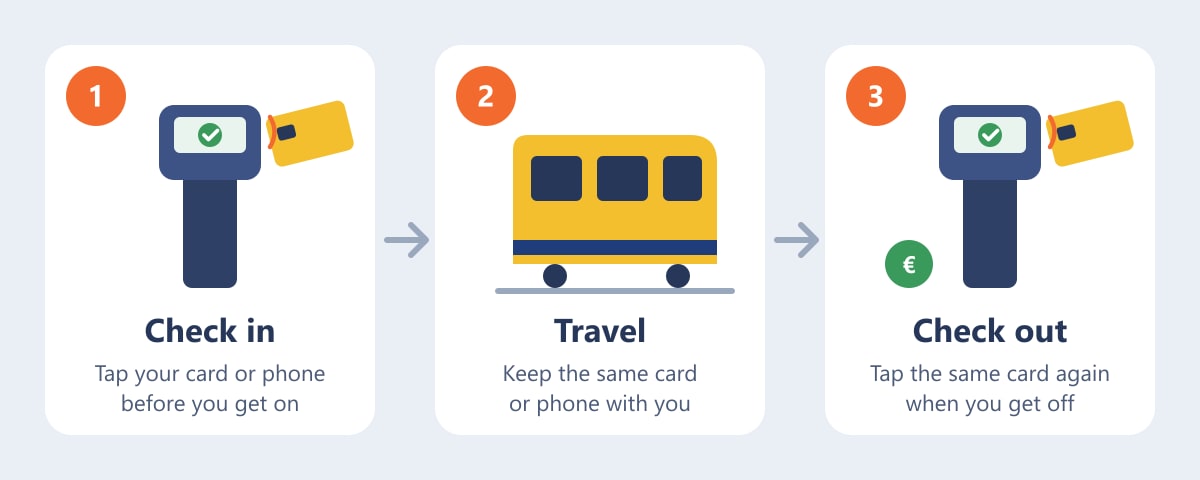
- Check in before you get on. At a train station, tap your card on a pole or gate before you go to the platform. In a bus or tram, tap the reader near the door when you get in. You hear a beep and see a green light or a tick.
- Travel. If an inspector comes, show the card or phone you checked in with. The inspector can see where and when you checked in, but not your bank details.
- Check out when you get off. Tap the same card again: at the gate or pole at the station, or at the reader near the door of the bus or tram.
- The money is taken from your account. NS takes the cost of all your trips of one day at once, so you might see one amount the next day. On your bank statement, it starts with NLOV.
Changing from a train to a bus? Then you check out of the train and check in on the bus. Changing from one train to another train, also of a different company? At some stations you need to check out at one company's pole and check in at the other company's pole. The colour and the logo on the pole show which company it's for.
The mistakes almost everyone makes once
- Using two different cards. Your bank card and the same card in your phone count as two different cards. Check in with your phone and out with the plastic card, and the system sees one trip without a check-out and one without a check-in. Take the card you use out of your wallet, so the reader doesn't pick the wrong one.
- One card for two people. That's not possible. Every person needs their own card or phone, also when you travel together.
- Sitting in first class. With a bank card, you may only travel in second class. The first-class parts of the train have a big yellow 1 on the door and the windows. If you sit there without a first-class ticket, you can get a fine of €70. Our guide on fines nobody warns you about lists more.
- Checked in by accident? Check out again at the same station within 60 minutes, and you pay nothing.
- Card blocked? If a payment didn't go through, for example because there wasn't enough money in your account, your card is blocked for public transport. Pay the open amount in the OVpay app. You can then travel again within about 15 minutes.
Forgot to check out? This is what happens
When you don't check out, the system doesn't know where you got off. So you pay a fixed amount instead of the real price of your trip. On NS trains in 2026, in second class, these are the amounts:
| What went wrong | What you pay first | How to get money back |
|---|---|---|
| Forgot to check out, with a bank card or phone | €33.30 | On ovpay.nl, from 6 hours after your trip. Fill in where you got off. The money is back in your account within 5 days. |
| Forgot to check out, with an OV-pas | €33.30 | In the OVpay app, from 6 hours after your trip. |
| Forgot to check in, but did check out | €20 | Same as above. |
| Forgot to check out, with an OV-chipkaart | The amount that was held back when you checked in (see below) | You can still check out up to 6 hours after you checked in. After that, ask for money back in your Mijn NS account, or on uitcheckgemist.nl for other companies. |
On buses, trams and metros, the fixed amount is lower, and each company has its own way to get money back. With a bank card or OV-pas, you can always do it on ovpay.nl or in the OVpay app.
What does a trip cost?
The price depends on how far you travel. Every trip has a fixed starting price, plus an amount for every kilometre. The NS app and the 9292 app show the price before you go. Some things to know:
- Prices go up every year on 1 January. In 2026, train tickets became 6.5% more expensive on average.
- With an OV-chipkaart, the train holds back a In Dutch: instaptarief. An amount that is held back on your card when you check in. You get back what you didn't use when you check out. of €20 when you check in. You get back what you didn't use when you check out. So you need at least that much money on your card. Buses, trams and metros hold back a smaller amount.
- With a bank card, nothing is held back. You just pay the price of the trip afterwards.
- In Amsterdam, GVB has a daily limit: if you check in and out with the same bank card, phone or OV-pas all day, you pay at most €10.50 a day for GVB buses, trams and metros.
Children, teenagers and people over 65
| Who | Train | Bus, tram and metro |
|---|---|---|
| Children up to 3 | Free. They don't need a card. | Free. They don't need a card. |
| Children aged 4 to 11 | Free with Kids Vrij, a free subscription, when they travel with someone aged 12 or older. The child needs a personal OV-chipkaart. Without Kids Vrij, a Railrunner ticket costs €2.50 for a day of train travel. | 34% off. Use a personal OV-chipkaart, or add the age discount to an OV-pas or bank card in an OVpay account. Children registered in Amsterdam or The Hague travel free within their own city. |
| Teenagers aged 12 to 17 | 40% off in off-peak hours with NS Flex Dal Voordeel, which is free until they turn 18. | Depends on the region. Check the website of the local company. |
| People aged 65 and over | Special cheaper subscriptions, like Weekend Vrij 65+ and Dal Vrij 65+. | 34% off with the age discount in an OVpay account. |
NS subscriptions: which one saves you money?
If you take the train more than a few times a month, a subscription from NS can save you a lot. All NS subscriptions for travellers are called The NS system for subscriptions. You don't load money onto a card. You travel first and get one bill a month for your trips and your subscription.. You don't load money onto a card with NS Flex. You travel, and at the end of the month NS takes the cost of your trips and your subscription from your bank account in one go.
These are the NS Flex subscriptions in 2026, with their monthly price for second class:
| Subscription | What you get | Price per month |
|---|---|---|
| NS Flex Basis | No discount. You pay afterwards, and you can rent an OV-fiets (see below). | €0, plus €10 once |
| NS Flex Dal Voordeel | 40% off in off-peak hours, at weekends and on public holidays. Up to 3 people travelling with you also get 40% off in off-peak hours. | €6.35 |
| NS Flex Weekend Vrij | Free travel at weekends and on public holidays. For €4 more, you also get 40% off on weekdays in off-peak hours. | €39.50 (or €43.50 with the weekday discount) |
| NS Flex Dal Vrij | Free travel in all off-peak hours, at weekends and on public holidays. | €127.95 |
| NS Flex Traject Vrij | Free travel between two stations you choose, for example your home and your work, at any time. 40% off other trips in off-peak hours. | Depends on the distance |
| NS Flex Altijd Vrij | Free travel on all NS trains, at any time. | €399.95 |
First class costs more, for example €169.95 a month for Dal Vrij. The two subscriptions Weekend Voordeel and Altijd Voordeel stopped on 1 July 2026, so you may still read about them, but you can't get them any more.
How to choose, in simple steps
- Look at when you travel. Only at weekends? Then Weekend Vrij. Mostly on weekdays outside the busy hours? Then Dal Voordeel or Dal Vrij. Every day in the rush hour? Then Traject Vrij or Altijd Vrij.
- Add up what you pay now. Look at your trips of last month in the NS app or on ovpay.nl. If you spend more than about €16 a month on off-peak trips, Dal Voordeel already pays for itself, because 40% of €16 is more than the €6.35 it costs.
- Compare with free travel. If your off-peak trips cost more than about €200 a month at the normal price, Dal Vrij is cheaper than Dal Voordeel. With Dal Voordeel you would pay €6.35 plus 60% of €200, which is more than the €127.95 of Dal Vrij.
- Ask your employer first if you want a subscription for your trips to work. They may pay for it, see the next part.
You take out an NS Flex subscription on ns.nl, with a Mijn NS account. You can change or stop most NS Flex subscriptions every month, after the first month. Check the conditions before you order.
A subscription doesn't work on your bank card
NS subscriptions don't work with a bank card or phone. If you travel with your bank card, you always pay the full price, even when you have a subscription. Today, most NS subscriptions are loaded onto a personal OV-chipkaart. NS is moving them to the new OV-pas. Do you already have an NS subscription? Then NS will tell you when and how to change. Don't order a separate OV-pas yourself, because your subscription won't be on it.
Travelling to work: what your employer pays, and your tax
Many Dutch employers pay for your trips to work. This is called a In Dutch: reiskostenvergoeding. Money from your employer for your trips between home and work.. There is no law that says they must, but it's very common. Look in your employment contract, or in your Collectieve arbeidsovereenkomst: an agreement about pay and working conditions for a whole sector or company. Many employees in the Netherlands fall under one. if you have one.
- Tax-free, up to €0.25 per kilometre. In 2026, your employer may pay you up to €0.25 for every kilometre you travel to work, without tax. This went up from €0.23 on 1 July 2026, and it counts for the whole of 2026.
- Or the real price of your tickets. For public transport only, your employer may also pay the real cost of your trips or subscription, tax-free, even if it's more than €0.25 per kilometre.
- More than that is taxed. If your employer pays more than these amounts, the extra counts as salary, and you pay tax on it.
- An NS Business Card. Some employers give you a train card in the company's name. You travel with it, and NS sends the bill to your employer, so you pay nothing yourself.
Our guide to your Dutch payslip shows where a travel allowance appears on it.
Your employer pays nothing? You may get a tax deduction
If you travel to work by public transport and your employer doesn't pay for it, you may be able to lower your income tax. This is called the In Dutch: reisaftrek openbaar vervoer. An amount you take off your income in your tax return, so you pay less tax.. You fill it in on your yearly tax return. It only counts if your work is more than 10 kilometres from home, one way. A deduction is not money you get back one for one: it's an amount taken off your income, so you pay less tax on it.
| Distance to work, one way | Deduction in 2026, if you travel 4 or more days a week |
|---|---|
| Up to 10 km | €0 |
| 11 to 15 km | €574 |
| 16 to 20 km | €762 |
| 21 to 30 km | €1,268 |
| 31 to 40 km | €1,572 |
| 90 km or more | €2,649 (the highest amount) |
If you travel fewer days a week, the amount is lower. If your employer pays part of your travel costs, you take that part off the deduction. The tax office has the full table. Our guide on your tax status explains when you file a tax return.
Bikes and trains
Renting an OV-fiets at the station
An A blue and yellow rental bike from NS that you can pick up at many train stations. is a rental bike you pick up at the station, for the last part of your trip. In 2026 it costs €4.80 for 24 hours. You can't rent one with a bank card: you need an NS Flex subscription on your card. The free NS Flex Basis is enough. The cost is added to your monthly NS bill. Bring the bike back to the station where you picked it up. Returning it somewhere else costs extra.
Taking your own bike on the train
- A normal bike needs a bike ticket, the Fietskaart Dal. It costs €8.50 for a whole day.
- Not in the rush hour: on weekdays, bikes aren't allowed from 6:30 to 9:00 and from 16:00 to 18:30.
- Always allowed at weekends, on public holidays (but not on King's Day), and all day in July and August.
- A folding bike is free at any time, as long as it stays folded for the whole trip.
- Get on at the doors with a bike sign, and don't block the doors or the walkway.
Delays, works and night trains
- Check the app before you go. Trains sometimes don't run because of works on the tracks (werkzaamheden), often at weekends. Then there are buses instead. The NS app and 9292 show this.
- Money back when you're late. If your NS train arrives 30 to 59 minutes late, you get half the price of your trip back. At 60 minutes or more, you get all of it back. Ask for it within 3 months. With an OV-chipkaart or OV-pas, use Mijn NS. With a bank card, use the online form on ns.nl. NS doesn't pay amounts under €2.30, or for delays caused by another train company.
- Trains at night. Every night, about once an hour, trains run between Rotterdam, The Hague, Leiden, Schiphol, Amsterdam and Utrecht. On other lines, the last train leaves much earlier, so check the time of your last train home.
A few Dutch train habits
- Let people get off first, then get on.
- Quiet areas: in parts of the train marked Stilte (silence), you don't make phone calls or talk loudly.
- Keep your feet off the seats, and don't put your bag on a seat when the train is busy.
- On the escalator, stand on the right and walk on the left.
Your checklist
- Download the NS app and the 9292 app.
- Check that your bank card is contactless, and decide: card or phone. Then always use that one.
- Check in before every trip and check out after every trip, with the same card.
- Forgot to check out? Fix it on ovpay.nl or in the OVpay app, from 6 hours later.
- Travel off-peak when you can. Take out NS Flex Dal Voordeel if you spend more than about €16 a month on off-peak trains.
- Have children? Get them a personal OV-chipkaart with free Kids Vrij, or add their age discount in OVpay.
- Ask your employer about a travel allowance or an NS Business Card before you buy a subscription for your trips to work.
- No travel allowance? Fill in the travel deduction on your tax return.
- Have an NS subscription on an OV-chipkaart? Wait for NS to move it to an OV-pas before the end of 2027.
Official sources and useful links
- NS: travelling with a payment card
- NS: forgot to check in or check out
- NS: correction fees and boarding fee (Dutch)
- NS: prices of subscriptions and tickets in 2026 (Dutch)
- NS: money back in case of delay
- NS: night trains
- OVpay: travelling with your bank card, and the OV-pas
- 9292: checking in and out with a bank card or phone
- 9292: discounts for children
- Rijksoverheid: the tax-free travel allowance from your employer (Dutch)
- Belastingdienst: table for the public transport travel deduction (Dutch)
This is general information based on the prices and rules in November 2026. Public transport prices change every year on 1 January, and each transport company can have its own rules. Always check the NS app, 9292 or the website of the company before you travel.