New to the Netherlands? Words with a have a short explanation. Tap or click them.
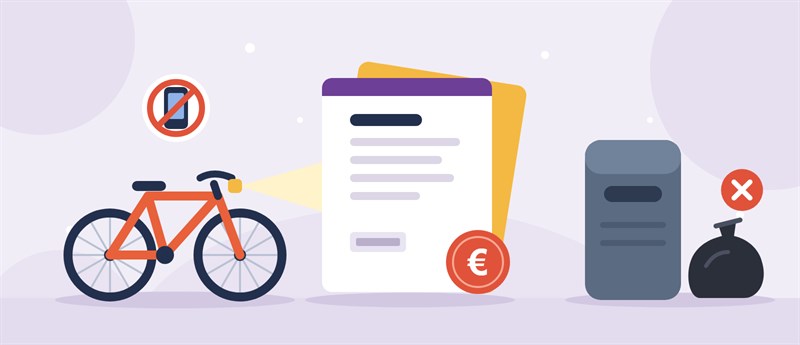
You cycle home in the dark, reading a message on your phone. You leave a bag of rubbish next to a full container. You forget to check out of the train. In your home country, nobody would notice. In the Netherlands, each of these can cost you money. Most newcomers get at least one fine in their first months, usually for something they didn't know was a rule. This guide lists the fines expats get most, what they cost in 2026, how the letter reaches you, and what to do if you think the fine is wrong.
The idea in simple words
The Netherlands has a lot of small rules, and it checks them. Police officers stop cyclists. Inspectors check tickets on the train. Cameras check speed and red lights. Town officers look at rubbish bags. And government offices check that you registered and took out health insurance.
Most fines are small and fixed: the same amount for everyone, written down in a national list. You pay them by bank transfer, and that's the end of it. The fine only becomes a big problem when you ignore the letter. Then it grows to one and a half times, and later three times the first amount.
The most important facts
- On a bike, your phone is the most expensive mistake: €170 for holding it while you ride. Cycling without lights costs €75, and cycling through a red light costs €120.
- Forgetting to check out on public transport isn't a fine, but you pay a fixed amount, often €20 on the train. Travelling without a valid ticket is a fine of €70.
- Rubbish next to a container is not allowed, even when the container is full. Many cities fine you about €95 to €200.
- Paperwork fines are the biggest: €529.74 for not taking out health insurance, up to €325 for registering late with your town, and €469 for a late tax return.
- Most traffic fines are sent by the Centraal Justitieel Incassobureau: the Dutch government office that sends out and collects fines.. €9 in admin costs comes on top. Since 1 July 2026, the CJIB sends a free reminder before the fine goes up.
Words you need to know first
- Fine (boete): money you must pay because you broke a rule.
- CJIB (Centraal Justitieel Incassobureau): the government office that sends most fines and collects the money. If you get a letter from the CJIB, it's almost always about a fine.
- BOA (buitengewoon opsporingsambtenaar): an officer who isn't police, but may give fines for some things. For example, town officers who check rubbish, parking and noise, and inspectors on the train.
- Reminder (betalingsherinnering, and later aanmaning): a letter saying you haven't paid yet. The first reminder is free. After that, each reminder makes the fine higher.
- Objection or appeal (bezwaar or beroep): the official way to say "I don't agree with this fine". There is always a deadline, and it's on the letter.
- Bailiff (deurwaarder): a person who may collect money you owe, for example by taking it from your salary or bank account. You never want a fine to get this far.
On your bike
Most newcomers buy a bike in their first week. Dutch cycling rules are mostly common sense, but the police do check them, especially in the autumn and winter, when it gets dark early. These are the national fines for 2026, for anyone aged 16 or older:
| What you did | Fine in 2026 |
|---|---|
| Holding your phone while you cycle, for example to read or send a message | €170 |
| Cycling through a red light | €120 |
| Not giving way to traffic from the right, where there are no signs | €120 |
| No working lights when it's dark or hard to see | €75 |
| Brakes that don't work | €75 |
| Cycling the wrong way, against the traffic | €75 |
| Not using the cycle path when there is one you must use (a round blue sign with a white bike) | €75 |
| Turning without showing it with your arm | €50 |
| No working bell | €50 |
| Cycling where a sign says you may not, for example in some shopping streets | €50 |
| Cycling after drinking too much alcohol. The limit is the same as for drivers. | €200 or more |
€9 in admin costs comes on top of each fine. For children under 16, the fine is half, and the parents pay. The government plans to raise most bike fines a little from 1 January 2027, for example to €180 for holding your phone. Those amounts weren't final yet when we wrote this.
Things that are allowed (and surprise many newcomers)
- A passenger on the back of your bike, on the luggage rack, is allowed.
- Cycling side by side with a friend is allowed, as long as you don't block other traffic.
- Headphones or earbuds are allowed. But it's safer to keep the volume low, so you hear bells and cars.
- Holding your phone when you have stopped, for example at a red light, is allowed. As soon as you ride on, it isn't. A phone in a holder on your handlebars is fine, as long as you don't hold it.
- Lights you clip on are fine. You need a white or yellow light at the front and a red light at the back, and they may not flash.
Your bike was taken away
Did you park your bike and now it's gone? It may not be stolen. Towns remove bikes that are parked in the wrong place, for example outside the bike racks near a station, in a spot with a "no bikes" sign, or for too long in a station bike park. The bikes go to a bike depot (fietsdepot).
- First check the website of your municipality, or the depot's website. Many have a search page where you can look up your bike by its frame number or colour.
- Bring your key and your ID to collect it. Some depots also ask for proof that the bike is yours.
- It costs nothing in some towns and up to about €50 in others. In The Hague, for example, it costs €25.
- Don't wait too long: depots keep bikes for a few weeks only. After that, they sell or recycle them.
E-scooters and mopeds
Thinking of bringing your electric scooter (e-step) from home? Most models are not allowed on Dutch roads. Only a few approved models are, and since 1 July 2026 they must have a blue number plate. Riding one that isn't approved can cost you a fine of several hundred euros. You also aren't insured, and the police can take the scooter. On a light moped with a blue plate (snorfiets), you must wear a helmet.
On the train, tram and bus
In the Netherlands, you check in when you start a trip and check out when you finish. You can do this with a bank card, a credit card or your phone (this is called The system that lets you check in and out on Dutch public transport with your own bank card, credit card or phone, without buying a ticket.), or with an The Dutch public transport card. You load money or a subscription on it and tap it on the card reader. The old version stops at the end of 2027..
- Forgot to check out? That isn't a fine, but you pay a fixed amount instead of your real fare. On the train, that's usually €20. On buses, trams and the metro, it's often €4. You can usually get the difference back: in the OVpay app or on ovpay.nl if you used a bank card or phone, or on the website of the transport company if you used an OV-chipkaart.
- No valid ticket? If an inspector finds that you didn't check in, or your ticket isn't valid, you pay a fine of €70. It's the same with every transport company. Sitting in first class with a second-class ticket counts too.
- Use the same card or phone to check in and out. If you check in with your phone and out with your bank card, the system sees two different trips, and you pay twice.
- Changing to another train company? At some stations, different companies have their own card readers. Check out at one and check in at the other. The signs on the reader show which company it's for.
- Keep enough balance on your OV-chipkaart. You can't check in without enough money on the card, and that's not an excuse for travelling without a ticket.
In the car
Cameras check speed and red lights on many roads. You won't be stopped. The fine just arrives by post a few weeks later, at the address of the person the car is registered to. That's the case even if someone else was driving. If you drive a lease car or a rental car, the company passes the fine on to you, often with its own extra admin fee.
| What you did | Fine in 2026 |
|---|---|
| Holding your phone while you drive | €440 |
| Driving through a red light | €320 |
| Parking in a disabled parking space without a disabled parking card | €500 |
| No seat belt | €190 |
| 10 km/h too fast in a town or city | €95 |
| 10 km/h too fast on a motorway | €84 |
€9 in admin costs comes on top. Going faster costs a lot more, and in roadworks or 30 km/h zones the fines are higher too.
Parking: a tax, not a fine
In most city centres you pay to park, usually with a card at the machine or with a parking app. If you don't pay, you get a In Dutch: naheffingsaanslag parkeerbelasting. A tax bill for parking you didn't pay for. It's sent by the municipality, not the police. from the municipality. It's officially a tax, not a fine. It is the price of one hour of parking, plus costs. In 2026, a municipality may charge up to €82 in costs, so one forgotten parking ticket can easily cost you €85 or more.
- Blue zone (blauwe zone): parking is free for a limited time, but you must put a blue parking disc (parkeerschijf) behind your windscreen. You can buy one at a petrol station or a hardware shop.
- Permit areas: in many neighbourhoods, only people with a permit may park. Your guests need a visitor's permit. Ask your municipality.
Two other car rules give expats big bills. Living here and keeping a car with foreign number plates is only allowed for a short time, and a driving licence from outside the EU is only valid here for 185 days. Our guides on expats and cars and exchanging your driving licence explain both.
Bins and rubbish
Every Dutch town has rules about how, where and when you put out your rubbish. Town officers check them, and they're one of the most common fines for people who have just moved in.
- Never put bags next to a container (bijplaatsing). This isn't allowed, even when the container is full. A Dutch court confirmed this again in 2026. Take your bag to another container, or wait.
- Put things out on the right day and time. Wheelie bins, bags and large items like old furniture may only go outside on the collection day, or the evening before. Your municipality's waste calendar tells you when.
- Large items like a sofa or mattress: book a free or cheap pickup with your municipality, or take them to the recycling centre yourself. Don't just leave them on the street.
- Fines differ per town. In the big cities, they're often about €95 to €200.
Good to know: officers sometimes open bags that are left in the wrong place, to look for a letter or a parcel with a name and address on it. So that envelope in your rubbish can lead them straight to you. Our guide Setting up your rental home explains how sorting rubbish works and how to find your collection days.
Paperwork fines: the biggest ones
These fines don't come from the police. They come from government offices, and they're for things you must arrange in your first weeks and months. They're also the most expensive.
| What you must do | Deadline | If you don't |
|---|---|---|
| Register your address with your municipality (if you stay longer than 4 months) | Within 5 days after you arrive, and within 5 days after every move | A fine of up to €325. Without registration, you also don't get a Burgerservicenummer: your personal Dutch ID number. You need it for work, banking, healthcare and taxes.. |
| Take out Dutch health insurance | Within 4 months after you register or start work | The Centraal Administratie Kantoor: the government office that checks that everyone has health insurance. sends a letter. If you still don't take out insurance within 3 months, you get a fine of €529.74, and later a second one. After that, the CAK takes out a policy for you and takes €172.70 a month from your salary for 12 months. |
| File your tax return, if the tax office sends you a letter asking you to | Usually 1 May of the next year, or later if you asked for more time | After a reminder, a fine of €469 the first time. It can go up to €6,709 if it happens more often. |
| Show your ID when the police or an officer asks for it (everyone aged 14 and older) | On the spot | A fine. The police may also take you to the police station to find out who you are. |
About ID: you don't have to carry it by law, but you do have to show it when asked, so in practice you need it with you. A copy or a photo on your phone doesn't count. Your passport, ID card or Dutch residence card does. A foreign driving licence usually doesn't. Read more in our guides to health insurance and your tax status.
How a fine reaches you and how to pay it
Sometimes you get the fine on the spot, and the officer writes down your details. Often it just arrives by post. Most fines come from the CJIB, in a white envelope with a purple edge. If you use the government's online mailbox, the The MijnOverheid Berichtenbox: your mailbox on the government website mijnoverheid.nl. You log in with DigiD. Many government offices send their letters there instead of by post., it can arrive there instead.
- You have 8 weeks to pay. The letter has the amount, a payment reference and a QR code. You can pay online or by bank transfer. Always use the payment reference.
- Not paid after 8 weeks? Since 1 July 2026, you first get a free reminder for a traffic fine, on a partly yellow letter. You then have 2 more weeks to pay the normal amount.
- Still not paid? You get a first official reminder (aanmaning), and the fine is now 1.5 times the first amount.
- Still not paid? A second reminder follows, and the fine is now 3 times the first amount. A €170 phone fine has then become €510, plus €9.
- After that, the CJIB can send a bailiff, take the money from your bank account or salary, or even take your car.
Can't pay it all at once? Contact the CJIB before the deadline and ask for a payment plan (betalingsregeling). This is possible for larger amounts. Asking costs nothing, and it stops the fine from going up.
Watch out for fake fines
Criminals send fake CJIB emails and text messages, for example: "Pay your fine of €320 within 24 hours". They link to a page that looks real and steals your money or bank details. A real fine almost always arrives as a letter by post, or in your Berichtenbox. Never pay through a link in an email, text message or WhatsApp message. Not sure? Go to cjib.nl yourself, by typing the address, and log in with Your personal login for Dutch government websites, like a digital ID card. to see the fines in your name.
Think the fine is wrong? How to object
Sometimes a fine is a mistake. The number plate was read wrong, you did check out, or the sign wasn't there. You may object, but you must do it in time and in the right way. The deadline is always on the letter.
| Type of fine | How to object |
|---|---|
| Traffic fine from the CJIB, like most car and bike fines | Send an appeal to the public prosecutor (officier van justitie) within 6 weeks. You usually must pay the fine first, as a deposit. If you win, you get it back. |
| Parking tax bill | Send an objection (bezwaar) to your municipality within 6 weeks. Most cities have an online form. |
| Fine on public transport | Contact the transport company. Do it quickly: if you don't pay and don't object, the fine can be passed on to the public prosecutor, and then it costs more. |
| Fine for rubbish, noise or other town rules | Read the letter carefully. Depending on the type of fine, you sometimes have only 2 weeks. |
| Fine from the CAK or the tax office | Send an objection to the office that sent it, within 6 weeks. |
Always add proof: photos of the place, a screenshot of your trip history, a parking receipt. Keep a copy of everything you send. Free advice is available from the Het Juridisch Loket: a free Dutch legal help desk, paid for by the government. You can call, chat or visit..
Your checklist to avoid fines
- Register with your municipality within 5 days of arriving, and within 5 days of every move.
- Take out Dutch health insurance within 4 months.
- Put lights on your bike, and put your phone away while you ride.
- Check in and out on every trip, with the same card or phone.
- Download a parking app, or always check the parking signs and machines.
- Look up your waste collection days, and never leave bags next to a container.
- Carry your passport, ID card or residence card.
- Open every letter from the CJIB, the CAK, the tax office and your municipality, and pay or object before the deadline.
- Never pay a fine through a link in a text message or email.
Official sources and useful links
- Rijksoverheid: how high are fines in the Netherlands (Dutch)
- Public Prosecution Service: the Boetebase, with every traffic fine (Dutch)
- CJIB: pay, check or object to a fine
- CAK: scheme for people without health insurance
- Rijksoverheid: when you must show your ID (Dutch)
- RDW: which e-scooters are allowed (Dutch)
- Juridisch Loket: free legal advice
This is general information based on the fines and rules in October 2026. Fines go up a little most years on 1 January, and town fines differ per municipality. Always check the amount and the deadline on your own letter.