
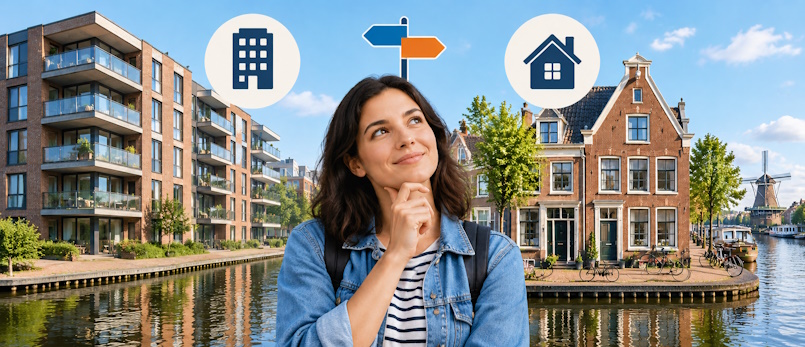
Choosing between an apartment and a house in the Netherlands is about more than space and stairs. Each type comes with its own rules, costs and responsibilities, especially if you buy. This guide explains the Dutch housing types, the practical differences, and the rules for renting and buying you need to know as an expat. All figures apply to 2026 and come from official Dutch sources.
Key Points at a Glance
- Renting: since 1 July 2024, new tenancy agreements are permanent by default. Deposits are capped at 2 months' basic rent.
- Buying an apartment means joining an owners' association (VvE). It's mandatory, and you share the costs of the whole building.
- Buying a house means you're fully responsible for maintenance and building insurance yourself.
- Transfer tax 2026: 0% for buyers aged 18–34 on homes up to €555,000, 2% if you'll live in the home, and 8% if you won't.
- Check for leasehold (erfpacht). It applies to both apartments and houses in some cities and adds an ongoing cost.
Dutch Housing Types Explained
Property listings use Dutch terms that don't always translate neatly. These are the ones you'll see most:
| Dutch term | What it means |
|---|---|
| Apartments (appartementen) | |
| Portiekflat / portiekwoning | Apartment reached through a shared stairwell, typically in older low-rise blocks, often without a lift. |
| Galerijflat | Apartment with its front door on an outdoor walkway (gallery) running along the building. |
| Benedenwoning / bovenwoning | Ground-floor or upper-floor home in a building split into separate homes. Common in older city neighbourhoods. A benedenwoning often has a garden, while a bovenwoning may have a roof terrace. |
| Maisonnette | Apartment spread over two floors with its own internal staircase. |
| Studio | Small self-contained apartment, usually one main room with its own kitchen and bathroom. |
| Penthouse | Apartment on the top floor, usually larger and with a terrace. |
| Houses (woonhuizen) | |
| Tussenwoning (rijtjeshuis) | Terraced house with neighbours on both sides. The most common Dutch house type. |
| Hoekwoning | The end house of a terrace, with one shared wall and often a larger garden. |
| Twee-onder-een-kap | Semi-detached house: two homes under one roof. |
| Vrijstaande woning | Detached house with no shared walls. |
Apartment vs. House: The Practical Differences
| Apartment | House | |
|---|---|---|
| Location | Dominant in city centres and near public transport. | More common in suburbs, smaller towns and newer neighbourhoods. |
| Outdoor space | Balcony or roof terrace, sometimes a shared courtyard. | Usually a private front and/or back garden. |
| Stairs and lifts | Older buildings often have steep stairs and no lift. Check this if you have small children, a bike or heavy furniture. | Typically several floors inside, with steep internal stairs. |
| Neighbours and noise | Neighbours above, below and beside you. House rules usually apply. | Shared walls in terraced and semi-detached houses, but no one above or below you. |
| Storage and bikes | Often a separate storage room (berging) in the basement or on the ground floor. | Often a shed in the garden. |
| Maintenance (if you buy) | Shared with other owners through the VvE: roof, facade, stairwell and lift. | Entirely your own responsibility. |
| Freedom to change things (if you buy) | Limited by the VvE rules, for example for exterior changes or a satellite dish. | More freedom, within municipal permit rules. |
Renting: Rules That Apply to Apartments and Houses Alike
Most rental rules in the Netherlands don't depend on whether you rent an apartment or a house. What matters is the rent level and whether the home is self-contained (its own entrance, kitchen, toilet and shower or bath).
Three rent sectors
| Sector | Starting rent (contracts starting in 2026) | What it means |
|---|---|---|
| Social housing | Up to €932.93 per month | Mostly let by housing associations to lower-income households. Usually long waiting lists. |
| Mid-rent | Up to €1,228.07 per month | Maximum rent set by a points system based on the home's quality. |
| Private (liberalised) sector | Above €1,228.07 per month | No maximum rent and no points system. Only possible for self-contained homes. |
For social and mid-rent homes, you can check the maximum legal rent with the Rent Tribunal's Rent Check. Annual rent increases are capped by law until 1 May 2029. In 2026 the maximum is 4.4%.
Your rights as a tenant
- Permanent contracts are the norm. Since 1 July 2024, new tenants get an open-ended tenancy. Fixed-term contracts of up to 2 years are only allowed for specific groups, such as students. Other temporary arrangements still exist, such as renting a home while the owner works abroad (diplomatenclausule) or under the Vacancy Act (Leegstandwet). These have their own rules, so check carefully which type you're signing.
- Deposit: a maximum of 2 months' basic rent for contracts from 1 July 2023. The landlord must return it within 14 days after the tenancy ends, or within 30 days if they deduct costs. They may only deduct rent arrears, service charges, damage you're responsible for, and an energy performance fee.
- No double agency fees: if the landlord uses a rental agent, the landlord pays the agent. The agent can't also charge you "administration" or "contract" fees.
- Service charges must reflect actual costs, and you must receive an itemised overview every year.
- Written contract: landlords must put tenancy agreements in writing, and inform you in writing about your rights and the deposit.
- Maintenance: as a rule, the tenant pays for minor repairs and the landlord for major repairs and maintenance.
- Disputes about rent levels, maintenance or service charges can go to the Rent Tribunal (Huurcommissie). For most cases it costs €25 for a tenant.
Apartment-specific points when renting
In an apartment building you'll usually pay service charges for shared areas, such as stairwell cleaning and lighting, a caretaker or the lift. If the owners have a VvE, its house rules (for example on noise, pets or bikes in the hallway) also apply to you as a tenant.
Rent benefit and permits
- Rent benefit (huurtoeslag) is only available for a self-contained home: one with your own living space, your own kitchen, your own toilet, your own shower or bath, and your own lockable front door. A shared front door, hallway, stairwell or lift doesn't count against you. Income, asset and registration conditions also apply.
- Housing permit: about half of Dutch municipalities require a housing permit (huisvestingsvergunning) to live in a social rental home. Conditions differ per municipality, so check with yours.
- Energy label: landlords and sellers must have a valid energy label and give it to the tenant or buyer.
Watch Out for Rental Scams
Never pay a deposit or rent before you've seen the home (in person or through someone you trust), checked that the landlord actually owns or manages it, and received a written contract. Deposits above 2 months' basic rent and separate "contract fees" charged by the landlord's own agent aren't allowed.
Buying an Apartment: Ownership Plus a VvE
When you buy an apartment, you're not just buying "your" apartment. You buy an apartment right (appartementsrecht): a share in ownership of the whole building, plus the exclusive right to use your own unit. Together with the other owners, you own the roof, facade, foundations, stairwell and other shared parts.
The owners' association (VvE)
- Membership is mandatory. Every apartment owner must be a member of the owners' association (Vereniging van Eigenaars).
- You pay a monthly or yearly contribution for building insurance, shared costs, cleaning and maintenance of the building.
- The VvE must save for major maintenance in a separate reserve fund. It calculates how much to save using a multi-year maintenance plan (MJOP) or by reserving at least 0.5% of the building's rebuilding value each year.
- Decisions are made in the owners' meeting, usually by a simple majority unless the rules say otherwise. That includes decisions to raise contributions for repairs.
- Everyone contributes to shared costs. The penthouse owner pays towards the sewer, and the ground-floor owner pays towards the roof.
The rules you agree to
- Deed of division (splitsingsakte): registered with the Land Registry (Kadaster), with a drawing showing exactly which parts are yours and which are shared.
- Division regulations (reglement van splitsing): rules on using shared areas and on paying shared costs. Usually based on a model regulation from a specific year.
- House rules (huishoudelijk reglement): everyday rules, for example on noise, pets or satellite dishes. The VvE meeting can change them.
What to check before you buy an apartment
- The deed of division and division regulations: what's private, what's shared?
- The house rules: pets, renting out, renovation and noise rules.
- The VvE contribution and what it covers (building insurance, heating, cleaning).
- The size of the reserve fund and whether there's an up-to-date MJOP.
- Recent minutes of owners' meetings: are big repairs or extra contributions coming?
- Whether the VvE is active, with a board, meetings and an insurance policy, rather than only existing on paper.
Buying a House: Full Ownership, Full Responsibility
With a house, you usually own the building and the land (unless there's leasehold, see below). There's no VvE, but that also means:
- You arrange and pay for all maintenance yourself, from the roof and window frames to the central heating.
- Mortgage lenders generally require building insurance (opstalverzekering) against damage from fire or storm, for example. In an apartment, the building is insured collectively through the VvE.
- Plan your own maintenance budget. No reserve fund is built up for you.
Leasehold (Erfpacht): Check It for Both
In some municipalities, notably Amsterdam, the land under a home isn't sold. Instead, you buy a leasehold right (erfpachtrecht) and pay the landowner, often the municipality, an annual fee called the canon. This can apply to apartments as well as houses. The seller must make clear that the home is on leasehold. It's shown on the listing (for example on Funda) and in the purchase contract.
Before you buy, check:
- Who the landowner is: a municipality, a housing association or a private party.
- Whether the leasehold is perpetual or for a fixed period, and when it ends.
- The current canon, whether it has been bought off, and when it will next be revised.
- Any restrictions in the leasehold conditions, for example on use or transfer.
Banks look closely at the canon and the leasehold conditions when deciding on a mortgage. A notary can explain the conditions to you.
The Costs of Buying (2026)
Transfer tax (overdrachtsbelasting)
| Situation | Rate |
|---|---|
| You'll live in the home yourself, you're 18–34, it's your first use of the starter exemption, and the home's value is at most €555,000 | 0% (starter exemption) |
| You'll live in the home yourself (other cases) | 2% |
| You won't live in it yourself, for example a home to rent out or a second home | 8% |
| Other property, such as commercial buildings or a separately bought garage box | 10.4% |
For the €555,000 limit, the full value of the home counts, including a garden, shed or garage bought with it, and the capitalised canon if it's on leasehold. If two people buy together, each is assessed separately: one may qualify for the exemption while the other pays 2%.
Other buying costs
- "Kosten koper" (k.k.): existing homes are usually sold on this basis, meaning you pay the transfer tax and the notary's fee for the transfer deed on top of the price. New-build homes are usually sold "vrij op naam" (v.o.n.), with these costs included.
- Optional costs: a buying agent, a structural survey (bouwkundige keuring) and a valuation report (taxatie), which your lender will usually require.
- Financing costs: mortgage advice, arrangement fees and the notary's fee for the mortgage deed.
- NHG (National Mortgage Guarantee): available for mortgages up to €470,000 in 2026, or €498,200 including energy-saving improvements. It costs a one-off 0.4% of the loan and usually gets you a lower interest rate.
Ongoing costs of owning
- Municipal property tax (OZB), based on the WOZ value set yearly by your municipality.
- VvE contributions (apartments) or your own maintenance budget (houses).
- Building insurance (houses) or your share of it through the VvE (apartments).
- Leasehold canon, if applicable.
Tax: mortgage interest and the notional home income
- If the home is your main residence, you add a notional income (eigenwoningforfait) to your taxable income. For most homes this is 0.35% of the WOZ value in 2026, for example €980 on a WOZ value of €280,000.
- You can usually deduct mortgage interest if the loan is repaid at least on an annuity or linear basis within 30 years. In 2026 the deduction is capped at a rate of 37.56%, even if part of your income falls in the 49.50% bracket.
Which One Is Right for You?
An apartment usually suits you if you want to live centrally near public transport, prefer shared and predictable maintenance, don't need a garden, or are staying for a shorter period.
A house usually suits you if you have children or pets, want a private garden and more storage, prefer full control over renovation and maintenance, or plan to stay long term.
Either way, check the energy label, the leasehold situation and (for apartments) the VvE's finances before you commit. These factors affect your monthly costs as much as the price or rent.
Official Sources
- Government.nl: rented housing (rent sectors, rent increases, Rent Tribunal)
- Volkshuisvesting Nederland: permanent tenancy contracts (Dutch)
- Volkshuisvesting Nederland: national rules for landlords (Dutch)
- Belastingdienst: which homes qualify for rent benefit (Dutch)
- Notaris.nl: buying an apartment (Dutch)
- Rijksoverheid: VvE reserve fund rules (Dutch)
- Notaris.nl: buying a home on leasehold (Dutch)
- Belastingdienst: starter exemption from transfer tax (Dutch)
- Belastingdienst: 8% transfer tax rate (Dutch)
- Rijksoverheid: costs of buying a home (Dutch)
- NHG: 2026 limit set at €470,000 (Dutch)
- Belastingdienst: notional home income (Dutch)
- Belastingdienst: mortgage interest deduction cap (Dutch)
This article gives general information based on official sources as of October 2026. Rent limits, tax rates and the NHG limit change every year, and some rules (such as housing permits and leasehold) differ per municipality. For advice on your situation, consult a notary, an independent mortgage adviser or the Juridisch Loket.
💡 Looking for a Home in the Netherlands?
Whether you're renting your first apartment or buying a family house, ExpatNL can put you in touch with trusted local experts, from rental agents to mortgage advisers and notaries, who are used to working with expats. Get in touch with us.


